The Axe and the Oath by Fossier Robert
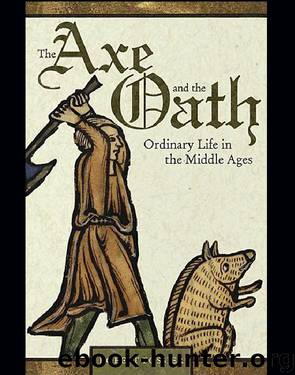
Author:Fossier, Robert. [Fossier, Robert]
Language: eng
Format: epub
ISBN: 978-1-4008-3614-7
Publisher: Princeton University Press
Published: 2010-01-04T16:00:00+00:00
KNOWING AND UNDERSTANDING
Immersed in the terrestrial and even the aerial animal worlds, man of the Middle Ages could not be content with being subjected to contact with the beasts. Fearing them and admiring them are passive attitudes. If only in order to limit their actions and attempt to dominate them, he had to study them and grasp their weaknesses.
What Are the Beasts?
The Church insisted that since animals had no soul and were simply a reflection of the power of God, studying them was neither useful nor desirable for salvation. Too much interest in them was close to idolatry. If sexual contact with animals could be proven among the groups of men who lived in isolation, as it was with shepherds in the mountains, the guilty party was charged with “bestiality” and burned at the stake for having insulted the Creator in his work. Thirteenth-century Scholasticism pointed to the dangers of totemization, the likening (in intellectual terms at least) of the beast, normally subject to man, and man himself, the only worthy object of study. Even the few who thought in zoological terms had an anthropological viewpoint, whether they were Isidore of Seville in the seventh century, Hildegard of Bingen in the eleventh century, or Brunetto Latini in the thirteenth century. Their thoughts about the animal world all followed the same schema. There are some animals who “serve” and others who “threaten”; the virtues that they display are of interest only if they contribute to the animal’s state of dependency and submission to man. This view did not change before the fourteenth century, when some began to take an interest in the animal world (or at least in looking at it), although without any change in the attitude of self-satisfaction with our own species and scorn for other species (a vanity that remains solid among our contemporaries). That slight change in evaluation was perhaps due to the development of a sense of the real that began to affect other areas as well and that was displayed in a curiosity about appearances, movements, and even mores. This was the epoch in which princes demanded menageries to amuse their guests and in which artists of the pen and the chisel perfected animal forms. King René amused himself drawing rabbits; Gaston Phoebus, the count of Foix, may have illustrated his hunting manuals himself. Still, Buffon was far in the future.
These concerns were matters for clerics, the learned, and the powerful. But what about the common people, the overwhelming majority of those who were in daily, physical, and natural contact with the world of beasts? In fact, if we can believe what we read in works about saints’ lives (which were written by learned men, however), or the romances and the fabliaux, we see that they knew as much, if not more, than the guardians of the Truth. The knowledge displayed in such works was direct and the observations visual; their authors remarked, registered in the minds, and at times cared for a horse’s maladies; they knew its fits of humor.
Download
This site does not store any files on its server. We only index and link to content provided by other sites. Please contact the content providers to delete copyright contents if any and email us, we'll remove relevant links or contents immediately.
| Africa | Americas |
| Arctic & Antarctica | Asia |
| Australia & Oceania | Europe |
| Middle East | Russia |
| United States | World |
| Ancient Civilizations | Military |
| Historical Study & Educational Resources |
Room 212 by Kate Stewart(5119)
The Crown by Robert Lacey(4814)
Endurance: Shackleton's Incredible Voyage by Alfred Lansing(4780)
The Iron Duke by The Iron Duke(4354)
The Rape of Nanking by Iris Chang(4211)
Joan of Arc by Mary Gordon(4109)
Killing England by Bill O'Reilly(4001)
Say Nothing by Patrick Radden Keefe(3984)
I'll Give You the Sun by Jandy Nelson(3447)
Shadow of Night by Deborah Harkness(3367)
Hitler's Monsters by Eric Kurlander(3342)
Mary, Queen of Scots, and the Murder of Lord Darnley by Alison Weir(3210)
Blood and Sand by Alex Von Tunzelmann(3203)
Eleanor & Park by Rainbow Rowell(3172)
Darkest Hour by Anthony McCarten(3129)
Margaret Thatcher: The Autobiography by Thatcher Margaret(3082)
Book of Life by Deborah Harkness(2938)
Red Famine: Stalin's War on Ukraine by Anne Applebaum(2933)
The One Memory of Flora Banks by Emily Barr(2863)
